

In recent weeks, renewed global tensions following the U.S.–Israeli military attack on Iran have been accompanied by a troubling rise in rhetoric rooted not only in geopolitics, but in apocalyptic religious framing. Reports of comments by Pete Hegseth suggesting that such actions could usher in “Biblical Armageddon” have sparked widespread concern among faith leaders and theologians alike. For many, this language reflects a dangerous convergence of political power and distorted religious interpretation—one that risks turning sacred belief into a tool of conflict rather than a call to peace.
This moment has renewed scrutiny of a broader and growing movement often described as Christian nationalism—the belief that the United States is, and should remain, explicitly Christian in identity and governance. Critics argue that this ideology does not simply express personal faith, but seeks to wield Christianity as a form of political authority, often at the expense of pluralism, democracy, and the core teachings of humility and justice found within the Gospel.
The pattern is not new. Donald Trump has long been criticized for invoking religious symbolism in ways that many faith leaders consider deeply problematic. One of the most widely cited moments occurred in the aftermath of the murder of George Floyd, when peaceful protesters gathered in outrage and grief. In a highly controversial scene outside St. John's Church, Trump held up a Bible as a prop following the clearing of demonstrators—an image that, for many, symbolized the weaponization of faith in service of political messaging rather than spiritual truth.
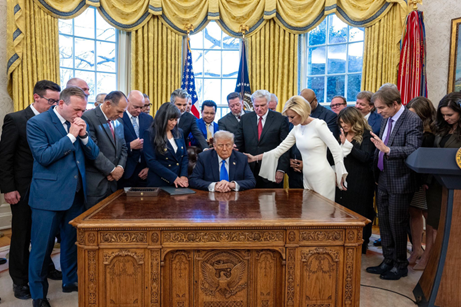
More recently, the normalization of in-office prayer within political spaces has raised similar concerns. While prayer itself is a sacred and meaningful practice, its use as a public performance tied to policy, power, or nationalism risks distorting its purpose. When faith becomes a tool to justify violence, exclusion, or dominance, it departs from its foundational call to love, mercy, and justice.
At the heart of these concerns is a theological reminder that stands in sharp contrast to apocalyptic speculation and political manipulation. In the Gospel of Matthew, we are cautioned against presuming to know the timing or unfolding of divine events:
“So you also must be ready, because the Son of Man will come at an hour when you do not expect him.” — Matthew 24:44 (NIV)
This verse is not a call to hasten or interpret global conflict as divine destiny, but rather a call to faithful readiness, humility, and ethical living. It underscores a truth shared across many Christian traditions: that no political leader, commentator, or nation holds the authority to claim knowledge of—or to attempt to precipitate—God’s ultimate purposes.
As public discourse grows more charged, faith communities are being called to respond with clarity and courage. The challenge is not only to reject the misuse of religion in public life, but to reclaim a vision of faith that centers peace over power, compassion over control, and justice over fear.


