

Open Letter: Economists Set the Record Straight on Millionaire Tax Migration in New York
Economists including Gabriel Zucman, Emmanuel Saez, Darrick Hamilton, and Isabella Weber agree, high-earner income tax increases raise revenue and do not motivate significant outmigration. Originally published in AMNewYork. View full list of signatures on New York City Policy Forum.
For many weeks, a high profile debate over the economic impacts of millionaire tax migration on New York has played out in the realm of public opinion: When legislators propose tax increases for high-income earners and profitable corporations, pundits and politicians sound the alarm that New York City’s wealthy will leave. Debate on this issue reached a fever pitch with the election of Zohran Mamdani to the mayor’s office. Without raising taxes, policies that would substantially improve the lives of working- and middle-class families—universal childcare, free buses, and two hundred thousand units of new affordable housing construction—will be jeopardized. The fate of such programs turns on the question of how New York’s taxes shape the City and State economy.
The case of high-earner tax migration poses the following economic questions: Will increased tax burdens cause high earners to leave New York City or New York State? If so, will they move in such high numbers as to decrease tax revenues? If not, are there other negative economic consequences for increasing top tax rates and potentially losing some number of high earners?
Recent evidence suggests the out-migration tradeoffs of raising income taxes on high earners are minimal. Such taxes may cause a very small number of millionaires to move, without undercutting public revenue generating potential. Recent examples of tax increases on high earners in both New York and Massachusetts demonstrate large revenue gains.
The underlying economic question concerns elasticity—for every 1 percent increase in the top marginal tax rate, what percentage of high earners will leave the jurisdiction subject to tax increase? In 2016, Cristobal Young, Charles Varner, Ithai Z. Lurie, and Richard Prisinzano analyzed tax increases on top earners in all fifty states and found an elasticity of approximately 0.1. That is, a 1 percentage point increase in the top marginal tax rate results in a 0.1 percent increase in outmigration flows—a nonzero, but still very small effect. The impact is likely even smaller in New York City, given the amenities and economic benefits of living in New York.
Similarly, Henrik Kleven published a working paper last year about potential downstream effects of increased taxation rates, accounting for positive results including decreased rent-seeking from employers and negative impacts such as reduced “trickle down” expenditures. The preliminary application of Kleven’s model found that the US would likely benefit from substantial increases in its top tax rate before externalities would begin to wipe out overall economic benefits.
Building on this academic literature, the Fiscal Policy Institute has published extensive research on the nature of outmigration in New York City. They found that the top 1 percent of earners are the least likely to move out of New York City, compared to the top 95–99 percent and bottom 95 percent income brackets.
The COVID-19 pandemic was the only major differential driver of high-earner outmigration in recent years. New Yorkers in the top income quintile were the most likely to leave the City during the lockdown, having much greater access to remote work than the general population.
In contrast, the past two major effective tax increases in New York have had comparatively minimal effect. The 2017 tax hike produced statistically negligible high-earner outmigration and the 2021 millionaire tax corresponded to a huge reduction in the rates of high-earner outmigration, as the large impact of the pandemic normalized.
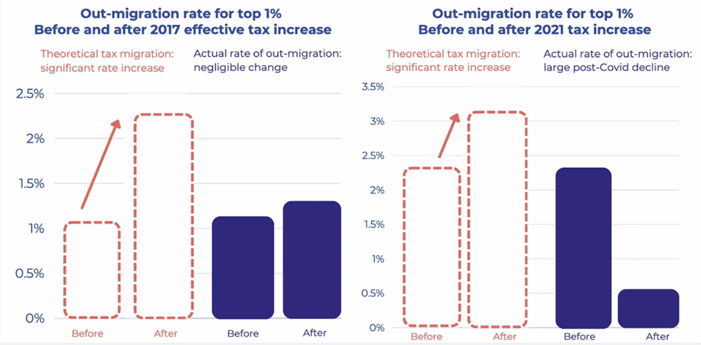
FPI also tracked the destinations of outmigrating residents of New York City and found that three-fourths of the highest earners who leave move to other states with high income tax rates, such as Connecticut, New Jersey, and California, making it unlikely that the pursuit of lower taxes was a motivator for their move.
The evidence is overwhelming and clear. Tax outmigration has a minimal effect on the tax bases of state governments seeking to tax the rich. It is a myth that top tax increases undercut New York’s overall tax base by driving away wealthy residents. For decades, this fiction has influenced New York City and New York State to undertax their wealthiest households and underfund vital social services and public infrastructure projects—placing lower- and middle-income New Yorkers at ever increasing risk of being driven out of New York City.
As the New York State legislature makes final considerations about the fiscal year 2027 budget, we, the undersigned, urge legislators and the governor to dismiss unfounded concerns of tax outmigration.
Gabriel Zucman, Paris School of Economics
Emmanuel Saez, University of California Berkeley
Darrick Hamilton, The New School
Isabella Weber, Economics professor, UMass Amherst
Sandile Hlatshwayo, International Monetary Fund
James A Parrott, Senior Fellow, Center for NYC Affairs at The New School
J.W. Mason, John Jay College, CUNY
Lauren Melodia, Center for New York City Affairs
Anisha Steephen, The Roosevelt Institute
Melanie Brusseler, Common Wealth
Rakeen Mabud, Common Wealth
Nathan Tankus, Notes on the Crises
Lenore Palladino, University of Massachusetts Amherst
Kitty Richards, Senior Fellow, Groundwork Collaborative
Weayonnoh Nelson-Davies, Economic Progress Institute
Lygia Sabbag Fares, John Jay College of Criminal Justice
Alex Jacquez, Groundwork Collaborative
Michael Ash, University of Massachusetts Amherst
Joseph Palomino, Arizona Center for Economic Progress
Leila Davis, University of Massachusetts Boston
Debipriya Chatterjee, Fiscal Policy Institute
Sina Sinai, Jain Family Institute
Ceren Baysan, University of Toronto
David Dyssegaard Kallick, Immigration Research Initiative
Elizabeth Cooper, Fiscal Policy Institute
Emily Eisner, Fiscal Policy Institute
Andrew Perry, Fiscal Policy Institute
Martin Bernstein, Harvard University (PhD student)
Breyon Williams, Groundwork Collaborative
Mark Paul, Rutgers University
Nicole Rodriguez, New Jersey Policy Perspective
Geert Dhont, John Jay College, CUNY
Alexandra Sirota, NC Budget & Tax Center
The Fiscal Policy Institute (FPI) is an independent, nonpartisan think tank that advances sound and equitable fiscal policy to strengthen New York’s economy through research, analysis and strategic communications.


