


Headed by the Reverend Jim Ketcham and Elder Chibueze Okiorie, Chairs, Criminal Justice and Re-Entry Task Team

We are committed to shaping a criminal justice system rooted in the premise of repentance, forgiveness, and restoration, not revenge and punishment. We also seek to address the root causes of crime including poverty and wealth inequality. Our goals are 1) to Keep people from going to prison in the first place. 2) if someone has the misfortune of being incarcerated that they receive the best pastoral and vocational assistance possible to restore themselves and get out of prison and 3) once they are out of prison to stay out and feel the society is erecting barriers that facilitate recidivism.
New York City: Addressing the horrific conditions at Rikers Island. Here is an article about the situation in Rikers in the Intercept and an editorial about Rikers in the New York Times. On September 24, New York City Congressional Democrats Called for Biden to Intervene at Rikers which included a call on the United States Justice Department to open a civil rights probe.
Following the lead of Trinity Church Wall Street and Interfaith Center of New York, New York State Council of Churches urges faith leaders to sign this letter to Borough President Eric Adams and Curtis Sliwa asking that when one or the other becomes Mayor, that they will commit to closing the jails on Rikers Island, and to invest in the policies that keep all our neighbors far away from Rikers Island. This letter allows you to sign on with just your name, the name of your faith institution, or both.
Albany: On November 2, City of Albany voters will go to the polls to vote on increasing the Community Police Review Board’s authority and ability to conduct investigations and to exercise oversight, review, and resolution of community complaints alleging abuse of police authority. For more discussion of this important proposition to increase police accountability read this article in Albany Proper
A statement from the New York State Council of Churches:
All who knew Chaplain Imam Abdallah Hadian at Marcy Correctional Facility and worked with him for many years are in mourning. The Imam committed suicide with his own gun, inside the walls of Marcy on Friday morning, November 7.
We remember the words of the Qu’ran “Inna Illahi wa inna ilayhi raji’un,” which means “Verily we belong to Allah and truly to Allah shall we return.
We pray for those of all faiths, who serve as chaplains in NYS DOCCS in these trying times. The shortage of guards since the illegal strike and the ongoing practice of some Corrections Officers calling in “sick” has placed tremendous pressure on all chaplains.
Chaplains in DOCCS often cannot hold worship services or other group gatherings because there aren’t enough COs to collect incarcerated individuals from their cells, escort them to the meeting place, remain with them and then escort them back. Civilian-taught classes and volunteer activities are also heavily curtailed or outright cancelled, along with visitation by family members.
Contributing to the tension, Corrections Officers are still being asked to work shifts as long as 12 hours and, as has been happening for years now, planned vacations are often cancelled.
DOCCS also arbitrarily “suspended” parts of the HALT (Humane Alternatives to Long Term Solitary Confinement) law, which limits who can be placed in solitary confinement and the length of stay. HALT also requires extra services to be provided to rectify whatever conditions led to the confinement, such as mental illness, anger management, PTSD, addiction, etc.
Corrections Officers claim that longer periods of solitary confinement are the only effective way to control residents, who they claim threaten the safety of COs or other incarcerated individuals. But right now, the required extra services cannot be provided in many state prisons, meaning people placed in solitary confinement will not get the help they need to correct problems.
Meanwhile, we know that long periods of solitary confinement only increase problems with mental and physical health. Indeed, theUnited Nations has declared that solitary confinement lasting more than two weeks is a form of torture and a violation of human rights.
Our state prison system is in a crisis. The pressures on incarcerated individuals, Corrections Officers, administrators - and chaplains - is only growing in intensity.
While Imam Hadian had also recently returned from a medical leave due to a stroke, the limits on what chaplains can do in the face of overwhelming need has been noted as a major stressor by many chaplains.
In response to this tragedy, we encourage our readers to reach out to console any of Imam Hadian’s co-workers, family and friends you may know. Let them know you are thinking of them and praying for them in this dark hour. Offer them a listening ear when you can.
In his memory, we also urge you to reach out to people who are incarcerated and their loved ones and those who were previously incarcerated who might find the news of Imam Hadian’s death to be especially traumatic.
We ask that you do what you can to advocate for policies and laws which will improve working and living conditions in prisons and ensure there are proper resources for staff to help residents rehabilitate and re-enter society.
We also urge you to contact Governor Hochul’s office by email (Governor.Hochul@exec.ny.gov) or by the Governor’s official contact form (https://www.governor.ny.gov/content/governor-contact-form) to ask that she sign the Robert Brooks Corrections Oversight Omnibus Bill, without amendments, before the end of this year.
This bill would expand and strengthen the State Commission on Corrections. Currently there are only 3 members, all appointed by the Governor, and traditionally drawn from a pool of retired law enforcement and corrections officers.
If Hochul signs this bill the number of commissioners will increase from 3 to 9, with the appointments distributed among the Governor, the NYS Senate and the NYS Assembly and the Correctional Association of New York (CANY).
Nominees for the Commission would also be drawn from individuals with experience in public health, behavioral health care, indigent legal defense, prisoners rights litigation, as well as formerly incarcerated individuals.
This expanded commission will be in a much better position to determine the safety and effectiveness of policies and practices in state and local correctional facilities. Other reforms included in the omnibus bill will also help regulate how corrections officials respond to complaints and provide for prompt and thorough investigations of deaths within all correctional facilities.
In closing, we offer a traditional Muslim du’a (prayer) for Imam Hadian, “Allah yarhamu:” May Allah have mercy on him.
We always welcome applications for chaplaincy from fully-ordained Protestant clergy with a Masters of Divinity and other qualifications who are committed to offering the very best pastoral care and spiritual guidance to people who are in prison. You can see a list of qualifications of an ideal candidate at www.nyscoc.org/programs/chaplaincy.
If you wish to offer care to those who are incarcerated or previously incarcerated, or to shape laws and policies which facilitate healing and rehabilitation, contact The Reverend Jim Ketcham, Chaplain Certification Coordinator and co-chair of the Criminal Justice Working Group of the New York State Council of Churches at jketchamnyscoc@gmail.com
Here are links to other statements made by our partners:
Correctional Association of New York
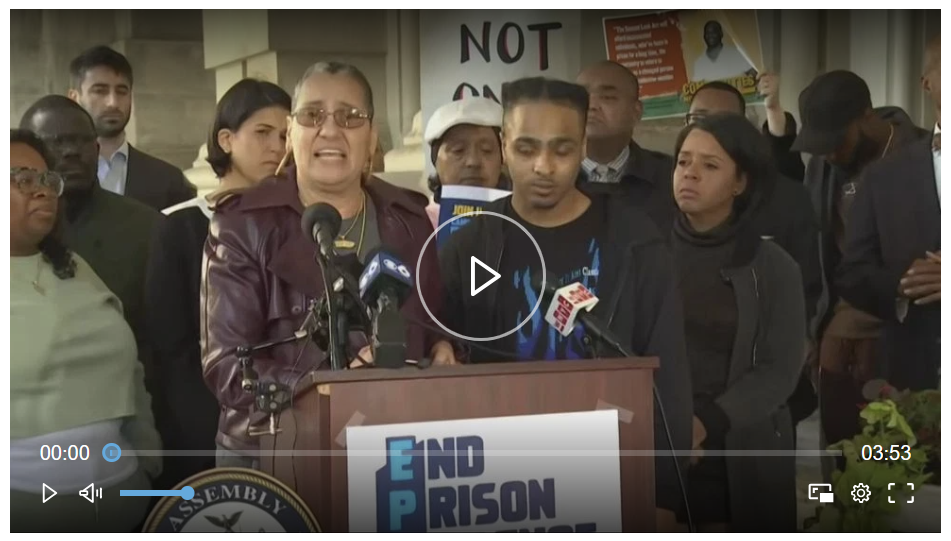
We had 50-60 people there, and there were at least a dozen TV cameras and a handful of print/radio reporters. I spoke as well (see below) but I don't know that I made the final cut for the broadcasts. Robert Brooks Jr. was very impressive.
Press Conference to Urge Governor Hochul to sign the Robert Brooks Omnibus bill without amendment.
Statement of Rev. Jim Ketcham, board member of the NYS Council of Churches:
As people of faith, we believe in redemption and restoration, not a life of exile behind bars.
As people of faith, we believe even those who have committed crimes are children of God, our brothers, our sisters, our children. No one should be judged forever by the worst decision they have ever made.
As people of faith, we condemn the use of violence and the torture of solitary confinement in our prisons and jails.
We condemn the systemic racism in our society, our policing and our justice system that leaves so many people of color behind bars.
The senseless brutality we have all observed in the video of the murder of Robert Brooks cannot be written off as an isolated incident, a matter of a few bad apples. Robert Brooks did nothing that could possibly explain his vicious beating. He was helpless, cuffed with his hands behind his back.
The pictures from those body cameras reveal that the years of rumors of random violence by Corrections Officers are more than just made-up stories. Messiah Nantwi’s murder adds to our sorrow and deep concern.
We know that people can turn their lives around in prison. Any chaplain can give you a dozen or more examples. We hear the frustration of chaplains who often cannot hold worship services or group discussions because there are not enough Corrections Officers to collect people, escort them, keep an eye on them, and escort them back. Entire volunteer programs and civilian taught classes have been put on hold indefinitely.
We need to hire more guards, train them better and finish implementing all the requirements of the HALT Act to provide the services that people in crisis need, services that can help end the need for drastic measures. We need to stop expecting corrections officers to work 12-hour shifts and be unable to take planned vacations.
And since no government bureaucracy can always police itself, we need more oversight of corrections, such as provided in the Prison Justice Omnibus bill through an expanded Commission on Corrections and greater authority given to the Corrections Association of New York.
Let there be no more deaths, no more beatings, no more brutality against helpless men and women.
We are people of faith who believe in redemption and restoration.
Tell Governor Hochul to sign the Omnibus Prison Reform Package now posted 10/20/2025
Support of 13th Forward Bill Package - updated May 27, 2025
2025 Advocacy Day Ask - Criminal Justice Reform
Top criminal justice issues for 2025 Session
January 2024 Testimony on Criminal Justice Reform
Memo of Support of Passage of Challenging Wrongful Convictions Act
View the Criminal Justice Seminar from our 2022 virtual NYS Ecumenical and Interfaith Advocacy Day.
On Friday, September 17, the Less is More Act was signed by Governor Kathy Hochul, preventing the re-incarceration of paroled prisoners based on technical violations. Here is a link to the signing ceremony which features speeches by the Governor Hochul, legislators and activists. Our Executive Director, Peter Cook, was able to participate in the signing ceremony.
Less is More will help keep more individuals out of jails and prisons including Rikers Island which holds an especially high number of individuals re-incarcerated for technical violations. The recent tour that Attorney General, Letitia James, and several other District Attorneys took of Rikers Island was helpful in getting news out to the public about the horrid conditions of New York City’s main jail complex. As the population of Rikers Island has grown by two thousand within the past year with eighty percent of its residents awaiting trial, the Less is More Act will be most helpful. Since Less is More will not be in force until March of 2022, Governor Hochul released 191 prisoners in Rikers Island right away. It is very important that Governor Hochul and Lieutenant Governor Benjamin continue to advocate for further criminal justice reform legislation and that the public lend their support in that effort.
Governor Cuomo signed into law the HALT Solitary Confinement Act which eliminates the use of long-term solitary confinement in jails and prisons. Many in the faith community for years have advocated for dramatic reductions in solitary which international human rights groups have rightly named as torture.
Now that the HALT Act is law, we are advocating for proper implementation and oppose current efforts at Rikers and other New York City jails to skirt the spirit of the law.
We also saw voting rights restored for those on parole. In New York, the general rule is that you can vote after incarceration for a felony conviction, or while you are on parole or probation. In these cases, your voting rights are automatically restored, but you have to re-register in order to vote. You do not need any special documentation to register.
On May 4, 2021, Governor Cuomo signed legislation to immediately and automatically restore the right of people on parole to vote in all elections.
Previously, as of 2018, New Yorkers who were on parole after incarceration for a felony could only have their right to vote restored on a case by case basis by a partial executive pardon that restored each approved person’s ability to register and vote.
With this new legislation, a clear rule of law has been established: if you are living in the community, you can vote in all local, state, and federal elections.
If you were previously registered to vote and were sentenced to prison, you will need to re-register to vote once you are released.
Criminal and correctional system officials are also required to educate people moving through the system about how your rights will be impacted, what resources are available to you and how to ensure you are registered to vote as soon as you return to your community.
Remaining Legislation
Fair & Timely Parole would require the parole board make decisions about release, to give more weight to how a person has transformed their lives rather than focusing on the original crime. The bill did not make it to the floor for a vote and advocacy is underway to see if the bill can still be voted S.2144/A.9040 upon in 2021.
The Elder Parole (S.2144/A.9040) would give a person, over the age of 55 and who has served 15 years, the right to have a parole hearing. The bill did not make it to the floor for a vote and advocacy is underway to see if the bill can still be voted upon in 2021.
You can find memos and other materials here on Elder Parole and Fair and Timely.
To read Peter Cook’s article in the Times Union in support of Fair and Timely, click here
Clemency. Freedom Unshackled is advocating to have the Governor dramatically increase the number of clemencies granted to 4 times a year to 50 men and 50 women each time, totaling 400 clemencies per year. Typically, we only see a handful of clemencies granted during the week between Christmas and NewYear's, but we know that justice cannot wait and we need to bring our loved ones home! #Clemency4xY.
Listen to this excellent commentary on the Brian Lehrer Show on clemency and parole by Steve Zeidman, professor and director of the Criminal Defense Clinic at CUNY LawSchool.
The CleanSlate bill allows S.1553A/A.6399)for expungement of a record 3 to 7 years after completion of parole. This bill sought to address the challenge of people being able to secure employ mentor housing because of their published record. We refer to these permanent paper trails as “paper handcuffs.” The bill did not make it to the floor, in part, because some lawmakers were concerned it would impede organizations (like churches) from doing background checks. We are hopeful these concerns can be addressed to enable the bill to move forward. The bill did not make it to the floor for a vote and advocacy is underway to see if the bill can still be voted upon in 2021
S.2960/Assembly Bill A.4565 Authorizes the city of Rochester to adopt a local law requiring a member of the police force in such city to be a resident of Rochester subsequent to the effective date of such local law. This bill did not get a floor vote
Senate Bill S.4462/AssemblyBill A.4566, also known as "Spit Hoods Ban” did not get a floor vote in the legislature.
Senate Bill S.4002/AssemblyBill A.5449, also known as "Chemical Irritants Ban,” Prohibits the use of chemical agents by police officers against minors under the age of eighteen. Bill did not get a floor vote in the legislature
S.4814/AssemblyBill A.4697, also known as "Daniel’s Law,” relates to establishing state and regional councils and regional response units for mental health emergencies; relates to certain powers of peace officers and police officers handling mental health emergencies. Bill did not get a floor vote in the legislature.
October 24, 2021, Gov. Kathy Hochul signed into law four bills meant to aid formerly incarcerated people, which, taken together, provide support to people who have served their sentences following conviction with an eye toward reducing recidivism, State of Politics reports.
H.R.1280 - George Floyd Justice in Policing Act of 2021
On the Federal level, the George Floyd Justice in Policing Act passed in the House March 3, 2021 but is now stalled in the Senate. This bill addresses a wide range of policies and issues regarding policing practices and law enforcement accountability. It increases accountability for law enforcement misconduct, restricts the use of certain policing practices, enhances transparency and data collection, and establishes best practices and training requirements.
The bill enhances existing enforcement mechanisms to remedy violations by law enforcement. Among other things, it does the following:
It establishes a framework to prevent and remedy racial profiling by law enforcement at the federal, state, and local levels. It also limits the unnecessary use of force and restricts the use of no-knock warrants, chokeholds, and carotid holds.
The bill creates a national registry—the National Police Misconduct Registry—to compile data on complaints and records of police misconduct. It also establishes new reporting requirements, including on the use of force, officer misconduct, and routine policing practices (e.g., stops and searches).
Finally, it directs DOJ to create uniform accreditation standards for law enforcement agencies and requires law enforcement officers to complete training on racial profiling implicit bias, and the duty to intervene when another officer uses excessive force.
Passed in the House, March 3, 2021. but remains stalled in the Senate.
News Update:
September 26, 2021: Month long bipartisan negotiations on the George Floyd Justice in Policing Act have collapsed. More information available here.


